Knowledge
Shopify ExcellenceGuide9 min

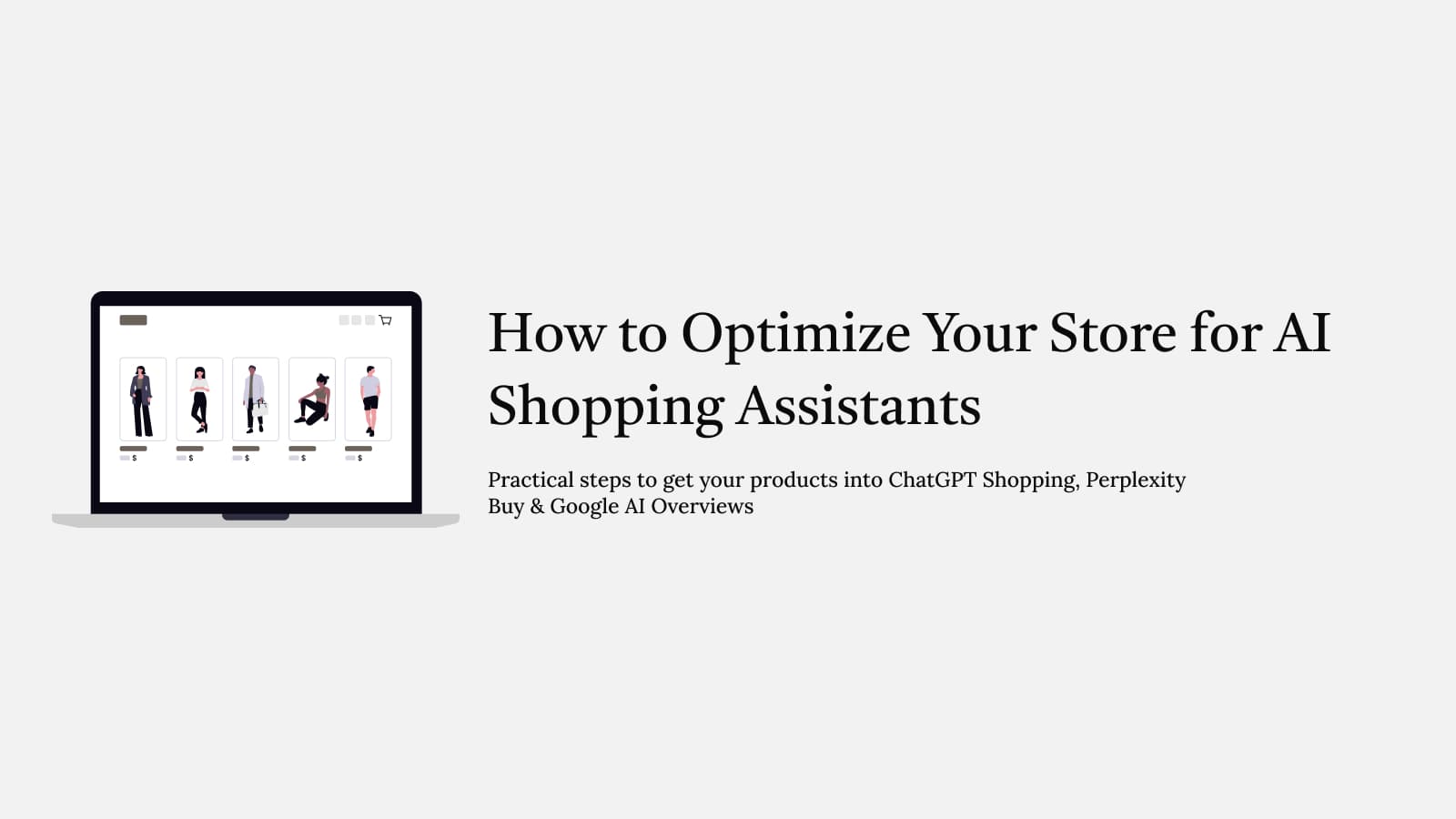
How to Optimize Your Shopify Store for AI-Powered Shopping Assistants

ChatGPT Shopping, Perplexity Buy, Google AI Overviews, and Shopify's own AI features are reshaping product discovery. Here's how to make sure your store gets recommended.

Last month, I asked ChatGPT to help me find a birthday gift for my niece — she's 12 and into astronomy. Within seconds, I got five specific product recommendations with prices, images, and direct purchase links. Three of the five came from Shopify stores. I then asked the same question to Perplexity. Different recommendations, same pattern: specific products, direct links, purchase options. One of the stores that appeared in ChatGPT didn't show up in Perplexity at all. Another store appeared in both — with slightly different products featured each time. This is the new reality of product discovery. AI shopping assistants — ChatGPT Shopping, Perplexity Buy with Pro, Google AI Overviews with shopping integration, and Shopify's own agentic storefronts — are becoming primary channels for how consumers find and buy products. They don't show ten blue links. They recommend specific products from specific stores. And the stores they recommend are the ones they can understand. AI referral traffic already converts 23% better and delivers 4.4x more value per visit compared to traditional organic search. With ChatGPT's 400 million weekly active users and Perplexity growing at 300% year-over-year, the stakes are enormous. This guide covers exactly how to optimize your Shopify store for every major AI shopping platform.

Understanding the AI Shopping Landscape

The AI shopping ecosystem has fragmented into distinct platforms, each with its own approach to product discovery and recommendations. Understanding these differences is essential for a multi-platform optimization strategy. ChatGPT Shopping is currently the largest AI shopping platform by user volume. OpenAI integrated product search directly into ChatGPT conversations, showing shopping carousels with product images, pricing, ratings, and direct purchase links. The products shown are not paid placements — they're selected based on product data quality, structured markup, reviews, and content authority. OpenAI pulls data from its own web crawling (via GPTBot), product feeds from partners, and the broader web ecosystem. Perplexity Buy with Pro takes a different approach. As an answer engine, Perplexity integrates purchase capabilities directly into its research-style responses. When a user asks a product-related question, Perplexity provides a detailed answer with cited sources and embedded product recommendations. Pro subscribers can complete purchases without leaving Perplexity. The platform relies heavily on its own crawler (PerplexityBot) and prioritizes stores with comprehensive, well-structured product information. Google AI Overviews represent the most significant shift for traditional SEO. Shopping-related AI Overviews appear above organic results and include product recommendations with pricing and availability data pulled from Google's product index. Stores already in Google Merchant Center have an advantage here, but the AI Overview also synthesizes information from organic content. Shopify's agentic storefronts, announced in early 2026, represent the platform's vision for AI-native commerce. These AI-powered experiences manage the entire customer journey — from discovery through purchase — using conversational interfaces. For Shopify merchants, this is the most direct opportunity to benefit from AI shopping because the optimization happens within your own store.

Don't optimize for just one platform. The customer who finds you through ChatGPT today might use Perplexity tomorrow and Google AI Overviews next week. A comprehensive data strategy works across all of them.

Step 1: Ensure AI Crawlers Can Access Your Store

The most common reason Shopify stores are invisible to AI shopping assistants is embarrassingly simple: they're blocking the AI crawlers that need to index their content. Every major AI platform sends its own web crawler to discover and index product information. OpenAI uses GPTBot and ChatGPT-User. Perplexity sends PerplexityBot. Anthropic uses ClaudeBot. Google uses Google-Extended for its AI features. If your robots.txt blocks these crawlers — which happens more often than you'd think — no amount of optimization matters because the AI systems literally cannot see your store. Check your robots.txt right now by visiting yourstore.com/robots.txt. Look for Disallow rules under any AI crawler user agents. Also check for blanket disallow rules that block all crawlers except Googlebot — a common legacy configuration that pre-dates AI search. In your Shopify admin, navigate to Settings and then to the robots.txt editing capabilities. Add explicit Allow rules for GPTBot, ChatGPT-User, PerplexityBot, ClaudeBot, and Google-Extended. Allow access to your products, collections, pages, and blog content. Block only sensitive paths: admin, checkout, account, and cart pages. Beyond robots.txt, check for other blocking mechanisms. Some Shopify apps and CDN configurations block non-Google bots at the server level. Rate-limiting configurations sometimes throttle AI crawlers too aggressively. If your server logs show AI bot requests being rejected with 403 or 429 status codes, investigate your firewall and CDN settings. After unblocking, it typically takes two to four weeks for AI crawlers to discover and index your store. You can accelerate this by implementing IndexNow, which proactively notifies search engines about your content instead of waiting for crawlers to visit.

After updating robots.txt, verify by checking server logs for AI crawler activity within two weeks. If you see GPTBot and PerplexityBot visits with 200 status codes, they're indexing your content.

Step 2: Create Your llms.txt File

If robots.txt tells AI crawlers what they can access, llms.txt tells them what your store actually is. It's a machine-readable summary of your business — think of it as your store's elevator pitch to AI systems. The llms.txt standard, proposed by Jeremy Howard in late 2024, has rapidly become the expected way for websites to communicate with large language models. The file sits at your domain root (yourstore.com/llms.txt) and provides a structured markdown overview of your brand, products, policies, and key information. For a Shopify store, an effective llms.txt file includes: your store name and a one-line value proposition. Key facts about your business — when you were founded, where you're based, what category you operate in, your price range. Your top 20-30 products with direct URLs and one-line descriptions that highlight what makes each product notable. Your main collections with links. Key policies — shipping, returns, warranty — that influence purchase decisions. Any trust signals — press mentions, certifications, awards, review platform ratings. The content should be factual and specific. AI systems extract facts, not marketing claims. 'GOTS-certified organic cotton sourced from Turkish farms, 220 GSM weight' is useful. 'The softest, most amazing cotton you'll ever feel' is not. On Shopify, deploying llms.txt requires a workaround since you can't upload files to the domain root directly. The standard approach is creating a Shopify page with the content and setting up a URL redirect from /llms.txt to that page. Alternatively, apps like Index AI generate and maintain the file automatically, keeping it current as your product catalog changes and serving it as proper plain text. Stores with a well-maintained llms.txt file see measurable improvements in AI citation rates within four to six weeks of deployment. It's one of the highest-ROI actions you can take for AI visibility.

Update your llms.txt whenever you launch new products, discontinue items, or change core policies. Stale information is worse than no information — AI systems may recommend products you no longer sell.

Step 3: Implement Comprehensive Structured Data

Structured data is the technical backbone of AI shopping optimization. It's the language that enables AI systems to understand your products at the granular level needed to make confident recommendations. When an AI shopping assistant evaluates whether to recommend your product, it needs machine-readable data points: exact price, currency, availability status, shipping details, review count and average rating, product specifications, brand information, and category classification. Schema.org structured data provides all of this in a format every AI system can parse. The minimum viable schema for AI shopping in 2026 includes Product schema with complete Offer data — price, priceCurrency, availability, itemCondition, and seller. AggregateRating schema with reviewCount and ratingValue if you have reviews. Individual Review schema for your most detailed reviews. Brand schema identifying the manufacturer or brand. FAQ schema answering common pre-purchase questions. Organization schema on your homepage establishing your business identity. Most Shopify themes include basic Product schema but miss critical elements. The gap between 'basic' and 'comprehensive' schema is where AI shopping visibility lives. AI systems are more likely to recommend products they can fully understand — a product with complete schema gives the AI confidence in the recommendation. Beyond your store's markup, Google Merchant Center plays an increasingly important role. Your product feed in Merchant Center powers Google AI Overviews' shopping recommendations. Ensure your feed is complete: detailed titles with key attributes, accurate pricing and availability synced in real-time, proper Google Product Category taxonomy, high-quality images meeting Google's specifications, and GTINs or MPNs where applicable. Implementing comprehensive schema across hundreds of products manually is labor-intensive. Template-level Liquid edits cover the basics, but dynamic data like reviews and FAQs requires either custom development or an app. Index AI automates the entire structured data stack — generating and maintaining schema across your catalog and keeping it synchronized with your actual product data.

Validate your structured data with Google's Rich Results Test and Schema.org's validator. Test at least five product pages. Every error reduces the chance of AI systems trusting your data enough to recommend your products.

Step 4: Optimize Product Content for AI Citations

AI shopping assistants don't just need structured data — they need rich, informative content that they can reference when explaining why they're recommending a product. The quality of your product content directly influences whether AI systems cite your store or a competitor's. Write product descriptions as if you're a knowledgeable salesperson having a conversation with a customer. Cover what the product is, who it's for, what makes it different from alternatives, and specific details about materials, dimensions, performance, and care. A description that says 'Premium leather wallet, handmade quality' gives an AI nothing to work with. A description that says 'Full-grain Italian leather bifold wallet, hand-stitched with waxed thread. Fits 8 cards, has an RFID-blocking lining, and develops a natural patina over 6-12 months of use. Made in our Florence workshop by artisans with 20+ years of experience' gives the AI everything it needs to recommend this wallet for specific queries. FAQs are disproportionately powerful for AI citations. AI systems operate in a question-and-answer paradigm — users ask questions, the AI provides answers. Product pages with structured FAQs that address common buyer questions give AI systems pre-formatted answers they can reference directly. Add three to five genuine FAQs per product: sizing and fit questions, material and care questions, comparison questions, and use-case questions. Blog content builds the topical authority that makes AI systems trust your product recommendations. A store that publishes genuinely helpful buying guides, comparison articles, and how-to content in their product category signals expertise to AI systems. This authority transfers to product recommendations — AI systems are more likely to recommend products from stores they recognize as knowledgeable in the category. Avoid thin, duplicate, or AI-generated filler content. AI shopping assistants are trained to evaluate quality. Content that reads like it was generated by a template or copied from manufacturer descriptions doesn't build authority.

For each product, write one paragraph answering: 'If a customer asked a knowledgeable friend whether to buy this, what would the friend say?' That conversational, honest tone is exactly what AI systems want to cite.

Step 5: Set Up Product Feeds and IndexNow

AI shopping platforms need fresh, accurate product data. Two systems ensure they get it: product feeds and IndexNow. Your Google Merchant Center product feed is the single most important data pipeline for AI shopping visibility. Google AI Overviews pull shopping data directly from Merchant Center. Ensure your feed includes every product in your catalog with complete data: descriptive titles (include product type, brand, key attributes — not just the product name), accurate real-time pricing, correct availability status, high-quality images, proper Google Product Category taxonomy, and GTINs or brand plus MPN identifiers. Feed quality matters more than feed size. A feed with 100 products that have complete, accurate data outperforms a feed with 1,000 products that have sparse descriptions and missing attributes. Google's AI evaluates feed quality when deciding which products to surface in AI Overviews. IndexNow ensures AI systems know about changes immediately. When you publish a new product, update a price, or mark something as sold out, IndexNow notifies supporting search engines within minutes rather than waiting days or weeks for their crawlers to discover the change. This is critical for AI shopping because recommending an out-of-stock product or showing a wrong price destroys user trust — and AI systems are designed to avoid that. Shopify doesn't natively support IndexNow, so you'll need an app. Index AI includes IndexNow as part of its feature set, automatically pinging search engines whenever your product data changes. There are also standalone IndexNow apps available. For ChatGPT and Perplexity specifically, there is no direct product feed submission (unlike Google Merchant Center). These platforms discover products through web crawling. This makes your on-site structured data, llms.txt, and content quality even more important — they're the only ways ChatGPT and Perplexity learn about your products.

Set up Google Merchant Center feed diagnostics and check weekly. Every disapproved product is a product that can't appear in Google AI Overviews. Aim for a disapproval rate under 2%.

Step 6: Monitor, Measure, and Iterate

Optimizing for AI shopping assistants is not a one-time project. The platforms are evolving rapidly, and your optimization needs to evolve with them. Set up AI referral tracking in Google Analytics 4. Create a custom channel group that captures traffic from chat.openai.com, perplexity.ai, copilot.microsoft.com, and other AI platforms. Many AI referrals currently show up as 'Direct' traffic because the platforms don't always pass referrer headers — but this is improving, and proper tracking ensures you capture what you can. Manually test your visibility regularly. Every two weeks, search for your product categories and specific products in ChatGPT, Perplexity, and Google (checking for AI Overviews). Note whether your products appear, how they're described, and which competitors show up instead. Document this in a spreadsheet to track changes over time. Monitor your server logs for AI crawler activity. Increasing visits from GPTBot, PerplexityBot, and other AI crawlers indicate that your content is being indexed more frequently — a positive signal. Decreasing visits might indicate blocking issues or crawl budget problems. Track your structured data health. Use Google Search Console's enhancements reports to monitor Schema.org errors and warnings across your site. Any increase in errors means AI systems are losing confidence in your data. Iterate based on what works. If ChatGPT recommends your competitor's product instead of yours for a specific query, compare your product page to theirs. Look at their structured data, content depth, FAQ coverage, and review volume. The gap between your page and theirs is your optimization roadmap. The AI shopping landscape will continue evolving. New platforms will emerge, existing ones will change their algorithms, and Shopify itself will add new AI-native features. The stores that build strong data foundations now and commit to ongoing optimization will maintain their advantage regardless of how the platforms evolve.

Create a monthly AI visibility report: track AI referral traffic, test visibility in the top 3 platforms for your top 10 product queries, monitor crawler activity, and check structured data health. This report becomes your optimization compass.

Conclusion

AI-powered shopping assistants are not a future trend — they're a current reality reshaping how consumers discover and buy products. ChatGPT, Perplexity, Google AI Overviews, and Shopify's own AI features are already driving meaningful traffic and revenue for stores that are optimized to be understood by these systems. The playbook is clear: unblock AI crawlers, deploy llms.txt, implement comprehensive structured data, write content that AI wants to cite, maintain fresh product feeds, and monitor your visibility continuously. Every step builds on the previous one, and the compound effect is significant. Start today — the stores optimizing now are building an advantage that gets harder to overcome with each passing month.

Key Takeaways

  • 01AI referral traffic converts 23% better and delivers 4.4x more value per visit — this is the highest-quality traffic channel available
  • 02Most Shopify stores are invisible to AI shopping assistants because they block AI crawlers in robots.txt — check yours immediately
  • 03llms.txt gives AI systems a structured summary of your store — deploy it manually or automate with Index AI
  • 04Comprehensive Schema.org structured data is the technical backbone — basic Product schema is no longer sufficient for AI shopping visibility
  • 05Google Merchant Center feeds power Google AI Overviews shopping — feed quality directly impacts whether your products get recommended
  • 06IndexNow ensures AI systems know about product changes within minutes instead of waiting weeks for crawlers
  • 07Monitor AI referral traffic in GA4, test visibility in ChatGPT and Perplexity biweekly, and iterate based on what competitors do better