Knowledge
Shopify ExcellenceGuide8 min

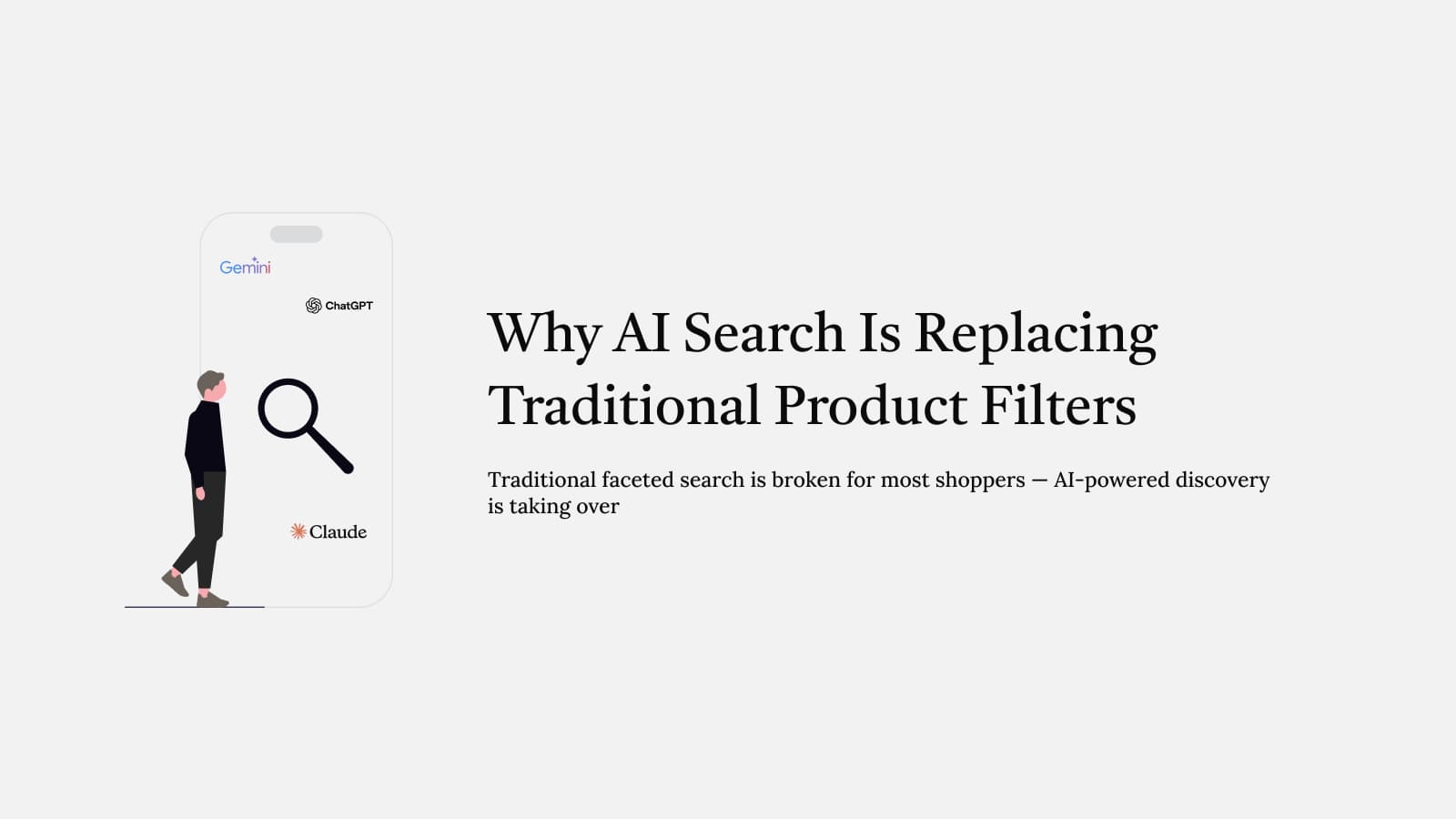
Why AI Search Is Replacing Traditional Product Filters (And What to Do About It)

Traditional faceted search is broken for most shoppers. AI-powered product discovery understands intent, not just attributes — and it's coming to every Shopify store.

A customer visits your store looking for a gift for their partner who runs marathons, has sensitive skin, and cares about sustainability. Your traditional product filters offer: Category, Size, Color, Price Range, Brand. None of those filters help this customer find what they need. So they leave. This scenario plays out millions of times daily across e-commerce. Traditional faceted search — the checkbox filters on your collection pages — was designed for a world where customers knew exactly what attribute they wanted to filter by. But most real shopping decisions aren't about attributes. They're about intent, context, and needs that don't map neatly to dropdown menus. AI-powered product discovery changes this completely. Instead of forcing customers to translate their needs into filter selections, AI search lets them describe what they're looking for in natural language. 'Running gear for someone with sensitive skin who cares about the environment' returns relevant results because the system understands intent, not just metadata. This shift is already happening. Shopify launched AI-powered search capabilities in its platform. Amazon has completely rebuilt its search around AI. Every major e-commerce platform is moving in this direction. The question for merchants isn't whether AI search will replace traditional filters — it's how quickly, and whether you'll be ready.

How Traditional Faceted Search Fails Shoppers

Faceted search was a breakthrough when it launched in the early 2000s. For the first time, customers could narrow down large catalogs by selecting specific attributes: size, color, price, brand. It worked well enough when e-commerce catalogs were small and customers knew exactly what they wanted. Two decades later, the model is cracking. The average Shopify store has grown from dozens of products to hundreds or thousands. Customer expectations have shifted from 'help me narrow down options' to 'help me find exactly what I need.' And the gap between what filters can express and what customers actually want has become a canyon. Consider the failure modes. A customer wants 'comfortable work shoes that don't look like sneakers.' No combination of filters gets them there. Another wants 'a moisturizer that works under makeup and won't break me out.' They'd need to understand ingredients to filter by that. A third wants 'something similar to what I bought last time but in a different style.' Filters have no concept of similarity or history. The data backs this up. Research from the Baymard Institute shows that 70% of e-commerce sites have faceted search implementations that fail to meet user expectations. Common issues include overly narrow filter combinations returning zero results, filter labels that use industry jargon customers don't understand, missing filter options for attributes customers actually care about, and no way to express subjective criteria like 'comfortable' or 'professional looking.' The result is what we call the 'filter abandonment loop' — customers click a few filters, get irrelevant results or no results, clear filters, try different combinations, get frustrated, and leave. We see this pattern repeatedly in session recordings across the stores we audit.

Watch 20 session recordings of customers using your collection page filters. Count how many end up clearing all filters and either browsing manually or leaving. That percentage is your filter failure rate.

How AI-Powered Product Discovery Works

AI product discovery replaces the filter paradigm with something fundamentally different: semantic search that understands meaning, not just keywords and attributes. Traditional search is literal. If a customer types 'blue dress,' it returns products with 'blue' and 'dress' in the title or tags. If your product is tagged 'navy' instead of 'blue,' it doesn't appear. If the customer types 'something to wear to a summer wedding,' traditional search returns nothing useful because no product is tagged with that phrase. AI search understands that 'something to wear to a summer wedding' means lightweight fabrics, semi-formal styles, bright or pastel colors, and probably a dress or jumpsuit. It understands that 'navy' is a shade of blue. It understands that 'won't irritate my skin' relates to hypoallergenic materials and fragrance-free formulations. This works through vector embeddings — mathematical representations of meaning. Every product in your catalog gets converted into a vector that captures not just its attributes but its semantic meaning. Customer queries get converted into vectors in the same space. The AI finds products whose vectors are closest to the query vector, effectively matching meaning to meaning rather than keyword to keyword. The practical result: customers describe what they want in their own words and get relevant results. No need to learn your taxonomy. No need to know which filters exist. No need to translate a nuanced need into checkbox selections. Shopify has been investing heavily in this direction. Their semantic search capabilities, powered by Shopify Magic, can already interpret natural language queries and match them to products based on meaning rather than exact keyword matches. Third-party apps like Algolia and Klevu have also shipped AI search features that go well beyond traditional keyword matching.

Test your current search with these queries: 'gift for my mom,' 'something for a beach vacation,' 'similar to [popular product name].' If the results are useless, your customers are having the same experience.

Conversational Commerce: The Next Evolution

AI search is just the beginning. The next evolution is conversational commerce — AI shopping assistants that guide customers through purchase decisions the way a knowledgeable salesperson would in a physical store. Instead of browsing and filtering, imagine a customer arriving at your store and chatting with an AI assistant: 'I'm redecorating my living room in mid-century modern style, budget around $2,000 for furniture, and I have a large dog so everything needs to be durable.' The assistant understands the aesthetic, the budget constraint, and the practical requirement. It recommends specific products, explains why each one fits, and handles objections — all in natural conversation. This isn't theoretical. Shopify announced and began rolling out AI-powered storefronts with conversational shopping capabilities. Amazon has Rufus, its AI shopping assistant that handles millions of queries daily. Klarna's AI assistant handled two-thirds of all their customer service chats within its first month, performing the equivalent work of 700 full-time agents. For smaller merchants, the implications are significant. Conversational commerce levels the playing field because the AI assistant can have deep product knowledge about a 50-product catalog just as easily as a 50,000-product catalog. A specialty store with curated products and detailed descriptions can offer a better conversational experience than a mega-retailer with thin product data. The key requirement is the same as for AI search: your product data needs to be rich, structured, and accurate. The AI assistant can only recommend products it understands. If your product descriptions are thin and your metadata is sparse, the assistant has nothing meaningful to work with — no matter how sophisticated the AI is.

Start documenting the questions your customer service team answers most frequently. These are exactly the queries a conversational AI assistant needs to handle. The answers become training data for better product recommendations.

What Merchants Should Do Now: Product Data Foundation

Whether AI search arrives at your store in three months or twelve, the preparation is the same: your product data needs to be comprehensive, structured, and semantically rich. Start with product descriptions. Every product needs a description that a human — or an AI — can use to understand what it is, who it's for, and why someone would buy it. Not keyword-stuffed SEO copy. Not a list of features without context. A genuine description that explains the product as a knowledgeable salesperson would. For each product, ensure you have: a clear, descriptive title that includes what the product actually is (not just a brand name and model number). A description of at least 100 words that covers use cases, materials, key features, and who it's ideal for. Complete metafields for all relevant attributes — material, dimensions, weight, care instructions, compatibility. Proper product type and category taxonomy using Shopify's standardized product categories. Tags matter more than ever, but not in the way most merchants use them. Stop using tags for internal organization ('sale,' 'homepage-featured') and start using them to describe product qualities that customers might search for: 'hypoallergenic,' 'gift-ready,' 'travel-friendly,' 'professional.' These semantic tags help AI systems understand products in the way customers think about them. Structured data via Schema.org ties it all together. AI systems — whether they're powering your on-site search, external platforms like ChatGPT, or Google AI Overviews — all rely on structured data to understand your products at a granular level. Comprehensive Product schema with offers, reviews, brand, and detailed attributes gives every AI system the information it needs to recommend your products accurately.

Pick your 10 best-selling products and rewrite their descriptions as if you're explaining them to a friend who asked 'what is this and why would I want it?' Then expand that approach across your catalog.

Real Examples: AI Search in Action

The shift from filters to AI-powered discovery isn't coming — it's already here across major platforms and increasingly in the Shopify ecosystem. Amazon's Rufus launched in early 2025 as an AI shopping assistant embedded directly in the Amazon app. Customers can ask questions like 'What do I need for a first camping trip?' and Rufus provides curated product recommendations with explanations. Amazon reported that Rufus handled hundreds of millions of queries in its first months, with customers who used it showing higher engagement and conversion rates. Shopify's own AI capabilities have expanded rapidly. Shopify Magic now powers semantic search that understands natural language queries. Shopify Sidekick helps merchants, but the consumer-facing AI features are what's transforming the shopping experience. Shopify's Winter 2025 Edition introduced AI-powered product recommendations and began testing agentic storefronts where AI manages the entire shopping experience. Perplexity launched its Buy with Pro feature, allowing users to purchase products directly within AI-generated answers. When someone asks Perplexity 'What's the best espresso machine under $500?', the response includes product recommendations with direct purchase links. Stores with proper structured data and strong product information get featured. ChatGPT Shopping, which OpenAI rolled out broadly in 2025, integrates product discovery directly into conversations. Users asking about products see shopping carousels with pricing, images, and direct links. The products that appear are selected based on structured data quality, review signals, and content authority — not paid placement. The common thread across all these examples: the AI surfaces products based on how well it understands them. Rich product data, comprehensive structured markup, and genuine content authority determine whether your products appear. Traditional SEO ranking is just one signal among many.

Search for your product category in ChatGPT, Perplexity, and Google AI Overviews. Note which competitors appear and analyze their product pages. What data do they have that you don't? That gap is your roadmap.

Preparing Your Shopify Store for AI-First Discovery

The transition from filter-based to AI-powered product discovery won't happen overnight, but the merchants who prepare now will have a compounding advantage. Step 1: Audit your product data completeness. Export your products from Shopify and check every field. How many have descriptions under 50 words? How many are missing metafields for material, dimensions, or care instructions? How many use vague titles like 'Classic Tee' instead of descriptive ones like 'Organic Cotton Classic Crew Neck T-Shirt — Heavyweight 220 GSM'? Create a completeness score and set a target: 90% of products should have complete data within 60 days. Step 2: Implement comprehensive structured data. Basic Product schema isn't enough. Add AggregateRating, FAQ, brand details, and product specifications in your Schema.org markup. Use an app like Index AI to automate this across your entire catalog. Step 3: Create your llms.txt file. This machine-readable summary of your store helps external AI systems — ChatGPT, Perplexity, Google AI — understand your business and product catalog. It's the single fastest way to improve your visibility in AI shopping recommendations. Step 4: Don't remove your existing filters — augment them. Add a search bar prominently above your collection page filters. Ensure your on-site search can handle natural language queries. Many Shopify search apps now offer AI-powered semantic search that works alongside traditional filters. Step 5: Monitor and measure. Track how customers use search versus filters in your analytics. Set up AI referral traffic tracking in GA4. Regularly test your store's visibility in AI shopping platforms. The data will tell you how fast the transition is happening for your specific customer base. The stores that act now — enriching product data, implementing structured markup, and preparing for AI-powered discovery — will be the ones that thrive as this transition accelerates. The ones that wait will find themselves invisible to the fastest-growing product discovery channel in e-commerce.

Set a goal: within 60 days, every product in your store should have a description over 100 words, complete metafields, proper Schema.org markup, and semantic tags. This is the minimum viable product data for AI-powered discovery.

Conclusion

Traditional product filters aren't going to disappear tomorrow. But the writing is on the wall — AI-powered product discovery is better for customers, better for merchants, and growing at an extraordinary pace. The stores that prepare their product data now, implement comprehensive structured markup, and embrace semantic search will capture the growing wave of AI-mediated shopping. The ones that rely solely on checkbox filters and keyword search will increasingly lose customers to competitors whose stores the AI actually understands.

Key Takeaways

  • 0170% of e-commerce faceted search implementations fail to meet user expectations — customers can't express nuanced needs through checkbox filters
  • 02AI search uses vector embeddings to match meaning, not keywords — understanding intent like 'gift for my mom' rather than requiring specific attribute selections
  • 03Conversational commerce is already here: Amazon Rufus, Shopify AI storefronts, and ChatGPT Shopping are handling millions of product queries
  • 04Product data quality is the foundation — rich descriptions, complete metafields, semantic tags, and comprehensive structured data determine AI visibility
  • 05Don't remove existing filters — augment them with AI-powered search and prepare your data for the transition
  • 06Stores that enrich product data now will have a compounding advantage as AI-powered discovery becomes the default